
Shotwell's history timeline, 1891 to 2006
1891
A Mission District Grocery Saloon
In 1891, two German immigrant businessmen—Schlichtmann and Bredhoff—opened a grocery saloon on the corner of 20th and Shotwell in San Francisco's Mission District. This format was common in the working-class neighborhoods of the American West: food and dry goods up front, beer in the back. One business, two purposes, one address.
It was a practical arrangement for a growing community of laborers, tradespeople, and families settled heavily by Irish, German, and Italian immigrants. You picked up your groceries and enjoyed a pint in the same trip. By the time Henry Schlichtmann bought out his partner to take sole ownership, he had moved his family into the apartment above. In that era, the work and the life were one and the same.
It was a practical arrangement for a growing community of laborers, tradespeople, and families settled heavily by Irish, German, and Italian immigrants. You picked up your groceries and enjoyed a pint in the same trip. By the time Henry Schlichtmann bought out his partner to take sole ownership, he had moved his family into the apartment above. In that era, the work and the life were one and the same.
1906
Survival and Reform After the 1906 Earthquake
The 1906 earthquake and fire tore through San Francisco and burned deep into the Mission, stopping just short of 19th and Capp Streets. As the city rebuilt, it enacted new laws intended to "civilize" the West Coast's largest city—then notoriously known as the Barbary Coast.
New regulations separated grocery stores from drinking establishments, a reform intended to keep children out of saloons. While the combined grocery/saloon vanished as a business type in San Francisco County, a few survivors still exist in rural California.
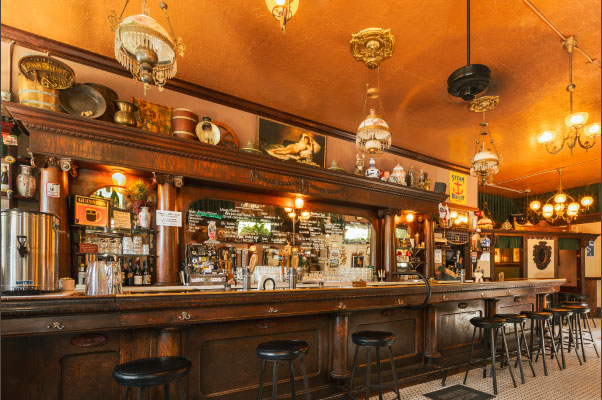
Schlichtmann obtained one of the newly limited saloon licenses and converted his corner business into a full-time saloon. He then made a purchase that would define the room for generations: a Brunswick back bar. Manufactured by the Brunswick-Balke-Collender Company, these ornate fixtures were the gold standard for American saloons. The bar you see today has been in this room for over a century.
Following the tradition of the American West—where reclining nudes were often hung over bars for the enjoyment of a predominantly male clientele—the current owners chose a reproduction of Francisco de Goya's "The Nude Maja." Painted for the King of Spain, the original now hangs in the Prado Museum in Madrid.
New regulations separated grocery stores from drinking establishments, a reform intended to keep children out of saloons. While the combined grocery/saloon vanished as a business type in San Francisco County, a few survivors still exist in rural California.
Schlichtmann obtained one of the newly limited saloon licenses and converted his corner business into a full-time saloon. He then made a purchase that would define the room for generations: a Brunswick back bar. Manufactured by the Brunswick-Balke-Collender Company, these ornate fixtures were the gold standard for American saloons. The bar you see today has been in this room for over a century.
Following the tradition of the American West—where reclining nudes were often hung over bars for the enjoyment of a predominantly male clientele—the current owners chose a reproduction of Francisco de Goya's "The Nude Maja." Painted for the King of Spain, the original now hangs in the Prado Museum in Madrid.
1909
The Prohibition Years
In 1909, Schlichtmann sold the saloon and used the proceeds to buy another bar nearby. Shotwell's was then operated by a series of owners, including an Irish woman who ran it just before Prohibition.
When Prohibition arrived in 1920, bars across the country pivoted or closed. Shotwell's converted back to a grocery store, but the back bar stayed put. We are incredibly lucky for this: many owners ripped out their original furnishings during the dry years. When Prohibition ended, those bars often replaced their old styles with then-fashionable Art Deco fixtures. Whether it was foresight, sentiment, or financial restraint, the carved bar Schlichtmann shipped across the country survived, waiting for the taps to open again.
When Prohibition arrived in 1920, bars across the country pivoted or closed. Shotwell's converted back to a grocery store, but the back bar stayed put. We are incredibly lucky for this: many owners ripped out their original furnishings during the dry years. When Prohibition ended, those bars often replaced their old styles with then-fashionable Art Deco fixtures. Whether it was foresight, sentiment, or financial restraint, the carved bar Schlichtmann shipped across the country survived, waiting for the taps to open again.
1933
The "Old Man Cribbin" Era
When Prohibition ended in 1933, a new owner, Mr. Cribbin, opened the space as a licensed beer parlor in 1934. He remodeled the space to create a corner entrance—the 1930s-era doors that welcome you today date from this period of rebirth.
Cribbin didn't just run the bar—he inhabited the corner. He cashed regulars' paychecks and offered credit and support to neighbors in need. For more than fifty years, he lived in the apartment above and tended the saloon below, steering the business through the Depression and the slow reshaping of the Mission District. By the end of his tenure, he was known simply as "Old Man Cribbin."
Cribbin didn't just run the bar—he inhabited the corner. He cashed regulars' paychecks and offered credit and support to neighbors in need. For more than fifty years, he lived in the apartment above and tended the saloon below, steering the business through the Depression and the slow reshaping of the Mission District. By the end of his tenure, he was known simply as "Old Man Cribbin."
1976
New Names, Same Corner
Following Mr. Cribbin's death in 1976, his family sold the building to Bob Schipero, owner of Light Soda On Tap. Under Schipero's ownership, the space hosted several different identities. First was El Tíbol, a rowdy, beer-only neighborhood bar, which later became Shotwell 59, named after a British motorcycle club. In 2000, Paul and Mike, two best-friend bartenders from Modesto, California, bought the business and ran it as Thieves Tavern.
Each chapter added its own layer to the room. At some point during these years, the bar acquired a small constellation of about six holes at roughly shin height across the front of the bar. By all appearances, they are bullet holes. The story behind them has been lost to time, which only makes them more intriguing.
Each chapter added its own layer to the room. At some point during these years, the bar acquired a small constellation of about six holes at roughly shin height across the front of the bar. By all appearances, they are bullet holes. The story behind them has been lost to time, which only makes them more intriguing.
2006
Shotwell's Today
In 2006, the bar found its current owners, Tom and David, who renamed it Shotwell's—honoring the street, the corner, and the long line of proprietors who came before. The name was a deliberate acknowledgment that this place belongs to its history as much as to whoever is currently running it.
Over the years, they have made the bar their own while honoring the past. Tom has added more historic memorabilia to the space, including a dedication to the Chinese immigrants who built so much of California, and after the COVID-19 shutdown, David, a seasoned horticulturist, added and lovingly tends a garden parklet.
The carved back bar is still here. The 1930s doors are still here. Those bullet holes are still here. What has changed most is what's on tap—a thoughtfully curated selection of beverages that would have likely baffled Schlichtmann and Cribbin, yet delighted them in equal measure.
More than 130 years after two immigrants opened a grocery saloon on this corner, Shotwell's remains a neighborhood anchor. We continue the tradition of California hospitality that has existed in this storied building since 1891.
Over the years, they have made the bar their own while honoring the past. Tom has added more historic memorabilia to the space, including a dedication to the Chinese immigrants who built so much of California, and after the COVID-19 shutdown, David, a seasoned horticulturist, added and lovingly tends a garden parklet.
The carved back bar is still here. The 1930s doors are still here. Those bullet holes are still here. What has changed most is what's on tap—a thoughtfully curated selection of beverages that would have likely baffled Schlichtmann and Cribbin, yet delighted them in equal measure.
More than 130 years after two immigrants opened a grocery saloon on this corner, Shotwell's remains a neighborhood anchor. We continue the tradition of California hospitality that has existed in this storied building since 1891.
Hours & location
Open daily from 3:30 p.m. on the corner of 20th Street & Shotwell in the Mission District.
Please, no big groups — we are a small neighborhood-focused bar.
| Days | Hours |
|---|---|
| Sunday – Wednesday | 3:30 p.m. – 11:30 p.m. |
| Thursday – Saturday | 3:30 p.m. – 12:00 a.m. |
3349 20th St, San Francisco, CA 94110
Get directions (opens in a new tab)
Follow us on Instagram
For up-to-date information and trivia nights, follow @shotwellsbar (opens in a new tab) on Instagram